

Faculty Handbook
This edition of the NOSM University Faculty Handbook contains policies and procedures pertinent to faculty at NOSM U. Due to the range of subject matter and authority, these policies and procedures are subject to change at any time. Revisions to the Faculty Handbook will be incorporated periodically. NOSM U Faculty are responsible for checking the website to keep abreast of alterations and additions.
Please note: This document must be downloaded and not simply opened for the hyperlinks to work correctly.
Should you have any Faculty Handbook-related questions, please contact:
Clinical Sciences Division – divclinsci@nosm.ca
Human Science Division – humscidiv@nosm.ca
Medical Sciences Division – medscidiv@nosm.ca
Faculty Toll-Free Helpline 1-877-678-7358 (If you reach the voicemail, please leave a message with your name and preferred contact information. Your call will be returned within 48 hours).
Welcome to NOSM University
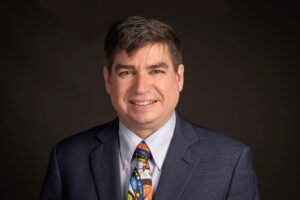
Welcome to NOSM University—Canada’s only independent medical university!
Thank you for joining our incredible NOSM University faculty and for sharing in our efforts to make access to health care better for everyone in Northern Ontario.
Since 2005, NOSM University has been delivering world-class health professions education to students and learners and remains committed to socially accountable research. As educators, researchers, innovators, and advocates, we have made a meaningful impact across Northern communities and beyond. I am confident that in your important role, you will help us to advance our unique vision: “Innovative Education and Research for a Healthier North.”
We are committed to supporting your professional growth and helping you thrive at NOSM University. If you have any questions or need assistance, please call our toll-free faculty line at 1-877-678-7358. You are also welcome to email us anytime at faculty@nosm.ca.
We hope you find your role fulfilling and inspiring. We are grateful to have you here to help make health equity in Northern Ontario a reality. We look forward to working with you.
Sincerely,
Dr. Michael Green
President, Vice-Chancellor, Dean and CEO
NOSM University
Bienvenue à l’Université de l’EMNO, la seule université autonome de médecine du Canada!
Merci de vous joindre à notre corps professoral remarquable et de contribuer à nos efforts pour améliorer l’accès aux soins de santé pour tout le monde dans le Nord de l’Ontario.
Depuis 2005, l’Université de l’EMNO offre de la formation de calibre mondial dans les professions de la santé et se fait un devoir de mener des recherches socialement responsables. Nos éducateurs, chercheurs, innovateurs et défenseurs des intérêts ont des incidences marquées dans les communautés du Nord et au-delà, et je suis convaincu que dans votre rôle important, vous nous aiderez à faire progresser notre vision unique : « Formation et recherche novatrices pour l’amélioration de la santé dans le Nord ».
Nous sommes déterminés à appuyer votre croissance professionnelle et à vous aider à prospérer à l’Université de l’EMNO. Si vous avez des questions ou besoin d’aide, vous pouvez appeler notre numéro d’appel sans frais pour le corps professoral au 1-877-678-7358 ou nous écrire en tout temps à faculty@nosm.ca.
Nous souhaitons que votre rôle soit enrichissant et inspirant. Nous vous sommes reconnaissants d’être là et de faire de l’équité en matière de santé dans le Nord de l’Ontario une réalité. Nous nous réjouissons de travailler avec vous.
Cordialement,
Dr Michael Green
Recteur, vice-chancelier, doyen et PDG
Université de l’EMNO
Vision, Mission, and Values
Vision
Health equity across the North.
Mission
Strengthen Northern communities and health systems through socially accountable health education and research. It is the special mission of the University to provide programs that are innovative and responsive to the needs of individual students and to the unique health-care needs of the people of Northern Ontario and other northern regions of Canada, which includes people living in rural, remote, Indigenous and Francophone communities. We will realize this by:
- Delivering an exceptional, learner-centric academic experience that equips learners with advanced health expertise and cultural competencies tailored to Northern needs. We are building a dynamic, inclusive, and culturally safe environment, responsive to Indigenous, Francophone, and rural communities. Importantly, we are ensuring our growth is financially sustainable to secure our long-term future as we continue shaping health education in the North. We are committed to continually improving the learner experience through innovation, collaboration, and reflection.
- Building strong, collaborative relationships with education, health, and community partners. Through shared initiatives and coordinated engagement, we are unlocking new opportunities in education, research, and health, together shaping a healthier, more connected North.
- Advancing a bold research agenda that tackles the unique challenges and opportunities of the North. Over the next five years, we will build the infrastructure and expertise to drive transformative, collaborative research, leveraging the talent and growing capacity across our communities and partners.
- Pursuing stable, long- term growth to enable us to deliver on our mission. Over the next five years, we will explore the optimal academic and administrative models to support this growth. We will also ensure our foundations—our buildings, technologies, systems, and people—are secure and adaptable to the needs of the University, and aligned to our commitments to Indigenous, Francophone, and rural interest holders.
Values
Inclusiveness
We foster an environment that honours diversity in people, cultures, and perspectives to build trust and mutual respect, and deliver benefits for individuals, the University, and the community.
Community
We are grateful that NOSM University is deeply rooted in the people, places, and institutions of Northern Ontario. We prioritize relationships and collaboration to strengthen local education and clinical capacity and improve health outcomes across the region
Adaptability
We are responsive to the unique health challenges and evolving needs of Northern Ontario and readily adjust our approaches to serve learners and communities effectively.
Excellence
We strive for excellence in education, teaching, research, and leadership that makes a tangible difference in the health of the North
To view NOSM U’s Strategic Plan, click here.
Section 1: Orientation
Faculty members will receive an orientation package at the time of appointment. Questions related to the orientation package should be directed as follows:
Clinical Sciences Division: divclinsci@nosm.ca
Human Sciences Division: humscidiv@nosm.ca
Medical Sciences Division: medscidiv@nosm.ca
Section 2: Framework for New Academic Programs
Recruitment and Hiring of Faculty and Staff
To view NOSM U’s new program development framework, click here.
Section 3: Clinical Teaching Position Description
Clinical Sciences Faculty Providing Clinical Teaching
The Clinical Sciences Faculty member who provides clinical teaching is a qualified health care professional and faculty member who practices in a clinical setting in which the learner will learn. The faculty member provides experience and opportunities for observation, which allow the learner to meet learning objectives. The faculty member also acts as a resource person during the learner’s placement.
Criteria:
- Licensed health care professional. This includes Health Science Professionals. To view a complete list, please click here.
- Qualified to assist the learner in meeting learning objectives in the clinical setting.
- Qualified by the faculty according to practice experience, clinical expertise, and educational expertise.
Responsibilities:
- Become acquainted with the objectives of the NOSM U clinical placement/clerkship.
- Become familiar with the learner’s individual learning objectives.
- With the learner, determine and arrange clinical experiences to help them meet their personal learning objectives.
- Provide the School with a list of skills and/or procedures that the learner may observe or perform, and specify which may require some advance preparation.
- Orient the learner to the clinical environment’s personnel, physical facilities, policies, and procedures.
- Assume supervisory responsibility for the learner’s practice.
- Provide periodic written assessments of the learner’s progress in meeting the learning objectives and the learner’s behaviour and responsibility in demonstrating a professional commitment to patients, staff, the Clinical Teacher, and the clinical setting.
- Maintain verbal and/or written communication with a designated School faculty or staff member.
- Assist the learner in becoming acquainted with the community’s people and activities.
Note: All Clinical Sciences faculty providing clinical teaching should have a NOSM University faculty appointment to formally assess a medical learner. For more detailed information on the various opportunities to be involved with NOSM U, please click here.
Section 4: Faculty Appointment and Reappointment Policy
To view the Policy, please click here.
Section 5: Distributed Medical Education Committee of the Council of Ontario Faculties of Medicine (DME-COFM)
The delivery of Distributed Medical Education (DME) in Ontario is enabled by the collaborative placement of medical learners from the six Ontario medical schools in clinical rotations across the province. The Distributed Medical Education Committee of the Council of Ontario Faculties of Medicine (DME-COFM) document linked below outlines the principles for collaborative distributed medical education across Ontario.
To view the document, please click here.
Section 6: Policy and Procedures for the Evaluation of Faculty Providing Clinical Teaching
To view the document, please click here.
Section 7: Professionalism for Clinical Faculty: Clinical Sciences Professionalism and Code of Conduct Policy, Procedures, and Professional Attributes Guidelines
Section 8: Learner Supervision and Addressing Learner Mistreatment
UME – Clinical Supervision of Medical Students Policy
To view the Policy, please click here.
UME – Delegation of Clinical Teaching Procedure
To view the Procedure, please click here.
PGME – Postgraduate Medical Education Supervision
To view the Procedure, please click here.
Addressing Learner Mistreatment:
To view the policy, please click here.
To view the webpage on Addressing Learner Mistreatment, please click here.
Section 9: Entitlements of Stipendiary Appointments
With an appointment, faculty enjoy:
- Faculty membership and an appointment with the University
- Regular notices and newsletters regarding activities and developments at the University
- Updates regarding medical advances in Northern Ontario
- Inclusion in a network of health professionals who share similar academic and clinical interests
- Opportunity to provide mentorship for future physicians
- Involvement in the recruitment of colleagues
- CME credits for participation in teaching and faculty development events
- Use of academic title for grants, promotions, and award applications
- Access to the NOSM University library and librarian support
- Access to NOSM U’s Alternate Funding Plan Agreement for participating physicians via Northern Ontario Academic Medicine Association (NOAMA)
- Access to virtual and in-house academic events at the University
- Access to online teaching materials and faculty development sessions
- Remuneration for many administrative roles within the University
- Stipendiary support for teaching activities
- NOSM University email and intranet accounts
- Opportunity to participate in a variety of research initiatives
- Access to the Research Support Group, which supports faculty with their research endeavours
- Access to research funds via NOAMA
- Fulfilling and rewarding career opportunities
Faculty members with stipendiary appointments are independent contractors, not employees of NOSM U. As per Section 4.2 of the NOSM U Policy and Procedures for Faculty Appointment and Promotion, faculty with stipendiary appointments are not eligible for:
- Tenure
- Sabbatical
- Pension and benefits
- Assigned office space
- Tuition waiver
Faculty with stipendiary appointments are responsible for the purchase of their own computers and other supporting technologies.
Section 10: Policy and Procedures Governing Joint and Stipendiary Faculty Promotions
To view the document, please click here.
Section 11: Joint and Stipendiary Faculty Appeal Procedure
To view the procedure, please click here.
Section 12: Clinical, Medical, and Human Sciences Faculty Salaries and Stipends
NOSM University Medical, Human, and Clinical Sciences Faculty: Non-Physician (Effective July 1, 2024)
Total Yearly Salary based on Daily Rate*:
Non Physician
| Rank | As of July 1, 2024 | As of July 1, 2025 |
|---|---|---|
| Lecturer | $17,984 | $18,523 |
| Assistant Professor | $22,597 | $23,275 |
| Associate Professor | $28,822 | $29,687 |
| Full Professor | $33,724 | $34,736 |
* The Daily Rate is calculated based on the floors and ceilings by academic rank.
NOSM University Clinical Sciences Faculty: Physicians (Effective July 1, 2024)
Total Yearly Salary based on Daily Rate:
Physicians
| Rank | As of July 1, 2024 | As of July 1, 2025 |
|---|---|---|
| Clinical Lecturer | $29,861 | $30,757 |
| Assistant Professor | $33,996 | $35,016 |
| Associate Professor | $39,422 | $40,605 |
| Full Professor | $44,852 | $46,197 |
* A clinical supplement is included in the physician’s daily salary rates. The supplement represents a value of $10,000 for each of four days/week worked. This is intended to compensate clinical faculty for the reduction in income on these four days. A “full-time” clinical appointment would be four days plus one clinical day. The stipend for part-time (i.e., 1-4 days) is shown on a per-day/week basis. Clinical faculty would not normally be full-time, except for administrators (Associate Deans, Division Heads).
NOSM University Stipendiary Faculty Administrative Stipends (Effective January 1, 2019)
Associate Dean
Associate Deans are senior academic administrators with a portfolio that carries broad program responsibilities for NOSM University and report directly to the Dean in these roles. Typically, Associate Deans may supervise Assistant Deans, Division Heads, Directors and/or Managers in their areas of responsibility. The position requires the incumbent to act in that capacity, on average, up to three days per week. Physician or non-physician base salary/daily rate + $20,000 administrative stipend.
Assistant Dean
Faculty in these positions report to an Associate Dean. The position requires the incumbent to act in that capacity on average 1 to 1-1/2 days per week. Physician or non-physician base salary/daily rate + $15,000 administrative stipend.
Division Head
Faculty in these positions supervise other faculty in their roles within the medical school. They collaborate to allocate faculty resources to the educational programs. The position requires the incumbent to act in that capacity, on average, up to three days per week. Physician or non-physician base salary/daily rate + $20,000 administrative stipend.
Phase Coordinators
Faculty in these positions supervise other faculty in their roles within the medical school. They have overall responsibility for the writing, design, development, implementation, and evaluation of the Years 1 and 2 rotations and the Year 3 Clerkship. The position normally requires the incumbent to act in that capacity on average up to three days per week. Phase 1 – Physician or non-physician base salary/daily rate + $15,000 administrative stipend.
Phase 2 Director
Faculty in these positions supervise other faculty in their roles within the medical school. They have the overall responsibility for the writing, design, development, implementation, and evaluation of the Year 3 rotations. The position normally requires the incumbent to act in that capacity on average up to three days per week. Phase 2 – Physician or non-physician base salary/daily rate + $15,000 administrative stipend.
Module Coordinator
The module coordinator will act as a liaison between the students, the appropriate Phase Committee, and the student assessment committee regarding assessment strategies for their module. This position requires a commitment of 1 day per week. Physician or non-physician base salary/daily rate + $5,000 administrative stipend.
Theme Course Chairs
Provide leadership and direction to Theme Committee members in the development of all aspects of the Theme in the NOSM U curriculum, including student assessment. Set agendas and meeting dates for Theme meetings. Supervise the activities of all Committee members in accordance with their responsibilities and expectations. Chair all Theme Committee meetings. Attend all Phase meetings to represent the Theme. Attend all UME Committee meetings. These positions require a commitment of 1 to 3 days, depending on the Theme. Physician or non-physician base salary/daily rate + $2,500.
Theme Writers/ Item Writers
Theme writers participate as a curriculum contributor for the writing group and complete independent writing items and examinations as assigned. Administrative Stipend – $500 to $2,000, depending on the complexity of the task.
NOSM U Theme 1 – 5 Committee Members
| wdt_ID | Position | Commitment (Days/Month) | Medical Doctor | Other Instructor |
|---|---|---|---|---|
| 1 | Stipend | 1 day/month | $500 | $300 |
| 2 | 2 days/month | $1000 | $600 | |
| 3 | 3 days/month | $1500 | $900 |
Theme 1 Committee Member
Contribute to the development of the Theme 1 (Northern and Rural Health) Course as a member of the Course Committee. The position requires a commitment of 1 to 3 days per month.
Theme 2 Committee Member
Contribute to the development of the Theme 2 (Personal and Professional Aspects of Medicine) Course as a member of the Course Committee. The position requires a commitment of 1 to 3 days per month.
Theme 3 Committee Member
Contribute to the development of the Theme 3 (Social and Population Health) Course as a member of the Course Committee. The position requires a commitment of 1 to 3 days per month.
Theme 4 Committee Member
Contribute to the development of the Theme 4 (Foundations of Medicine) Course as a member of the Course Committee. The position requires a commitment of 1 to 2 days per month.
Theme 5 Committee Member
Contribute to the development of the Theme 5 (Clinical Skills in Health Care) Course as a member of the Course Committee. The position requires a commitment of 1 day per month.
Postgraduate Medical Education (PGME) Related Roles
Competence Committee Member (RCPSC Residency Programs)
Competence Committee members make group decisions based on patterns of performance evidence to inform postgraduate resident progression in their program. Committee members exercise judgment in making decisions and status recommendations, guided by the national specialty competency framework.
Education Advisory Committee Member
Education Advisory Board members provide effective advice, resources, and support to any Residency Program, Program Director, or Resident requesting guidance on creating and implementing effective individual educational/learning plans, particularly regarding remediation periods.
Evidence-Based Medicine (EBM) Tutor
Under the direction of the EBM Coordinator and a Program Director, EBM Tutors prepare and deliver EBM tutorial sessions for postgraduate residency program academics. Tutors participate in program and curriculum planning.
Research Tutor
Reporting to either a Program Director or a residency program Research Coordinator, the research tutor is responsible for facilitating the development of research skills for postgraduate residents. The tutor is responsible for facilitating tutorial sessions at Academics and may also provide direct one-to-one support.
Continuing Professional Development (CPD) Related Roles
Scientific Planning Committee (SPC) members
Every accredited continuing professional development (CPD) activity must have a planning committee (SPC). At the discretion of the committee, faculty who serve as members of the SPC may be compensated for their involvement in the development, planning, and implementation of CPD activities. CPD content includes Continuing Medical Education (CME) and Faculty Development (FD) activities.
Rates: $200 for the first hour, then $150 for each additional hour to a maximum of $500 per half day
Continuing Professional Development (CPD) Subject Matter Experts (SMEs)
At the discretion of the Scientific Planning Committee, faculty who participate as SMEs may be paid for the creation and development of continuous professional development (CPD)-related materials. CPD content includes Continuing Medical Education (CME) and Faculty Development (FD) activities.
Administrative Stipend – $500 to $2,000, depending on the complexity of the task
Delivery of Continuous Professional Development (CPD) activity
At the discretion of the Scientific Planning Committee, faculty who are invited to deliver CPD content (such as workshop presenters at a conference, in-person faculty development presenters, etc.) may be compensated for their time. CPD content includes Continuing Medical Education (CME) and Faculty Development (FD) activities.
Administrative Stipend – $200 to $500, depending on the complexity of the activity
Peer-to-Peer CPD Facilitation
For activities delivered through the Continuing Professional Development (CPD) portfolio, faculty who facilitate Faculty Development (FD) or Continuing Medical Education (CME) for peer faculty or clinical colleagues may be compensated for their facilitation time. Peer-to-peer CPD refers to faculty teaching professional peers.
Rates: Flat rate of $500 per workshop.
The following roles have salaries calculated using the Physician Leadership Evaluation Tool* and have therefore been deleted from the Faculty Handbook: Phase Three Coordinator, Clerkship Leads, Section Chairs, and Directors. Other roles with salaries calculated with the Physician Leadership Evaluation Tool include:
Medical Advisors, Medical Directors, Global Health Coordinator, Site Liaison Clinicians, Francophone Lead, Francophone Education Lead, Evidence Based Medicine Coordinator, Research Coordinator, IMG Coordinator, ICU Coordinator, Evaluation Coordinator, Psychotherapy Coordinator, Regional Director, Research Tutor, FM Academic Coordinator, FM Academic Resource Coordinator, Enhanced Skills Coordinator, CTU Director, Program Director, Active Site Director, Developing Site Director, Major Site Director, Academic Coordinator, Rural FM Director.
*The Physician Leadership Evaluation Tool is designed to recognize the primary elements of physician leadership roles, including but not limited to complexity, contacts, rank, qualifications, use of judgement, independence of action and qualifications
NOSM University Rates for Instructional Hours: Small Group Facilitation/Clinical Lecturer, etc. (Effective 2017/2018*)
| wdt_ID | Description | Rates Per Hour |
|---|---|---|
| 1 | Medical Doctors | – $200/first hour then – $150/each additional hour to a maximum of $500/half day |
| 2 | Other Instructors | – $100/first hour then – $75/each additional hour to a maximum of $250/half day |
| 3 | Other Instructors – WGS/Lab Lectures/DTS | – $200/first hour then – $150/each additional hour to a maximum of $500/half day |
Section 13: Clinical Teaching Compensation Plan
To view the document, please click here.
Section 14: Faculty Remuneration Process
Faculty Remuneration Process
*Refer to the following Appendix A for further details on this process.
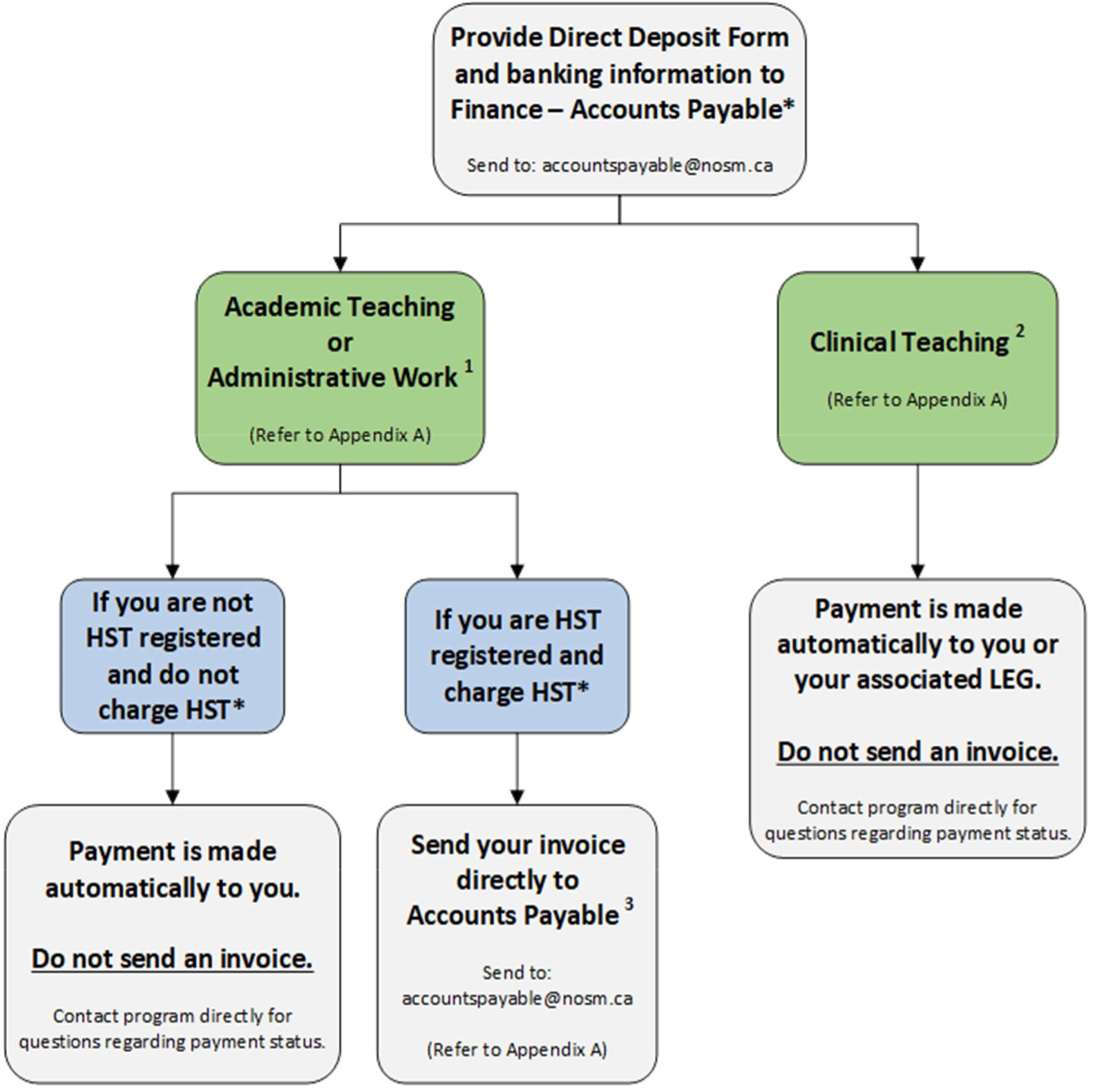
For any questions regarding HST, or if there are any changes to your banking or your HST registration status, please contact accountspayable@nosm.ca.
Appendix A: Faculty Remuneration Process
Academic Teaching
Academic teaching generally includes lectures/seminars/teaching sessions (in person or virtually), facilitation of academic sessions, participation in competence committees, and simulation and skills training outside of a clinical rotation/learning experience. This would also include preparatory work, designing subject learning objectives, assessing comprehension throughout course delivery, and evaluating teaching effectiveness. Academic teaching rates are often used to benchmark other academic work, such as remediation or enhanced learning plan (ELP) coaching.
For Resident teaching: If you are in doubt, the PGME program contact you are working with will advise you on payment classification and any necessary pre-approvals required.
Clinical Teaching
The Clinical Sciences Faculty member who provides clinical teaching is a qualified health care professional and faculty member who practices in a clinical setting in which the learner will learn. The faculty member provides experience and opportunities for observation, which allows the learner to meet learning objectives. The faculty member also acts as a resource person during the learner’s placement. A Preceptor teaching in the clinical environment would fall into this category.
For details, please refer to the Clinical Teaching Compensation Plan.
Invoice Requirements (when a vendor is registered for HST)
HST- registered vendors must submit invoices directly to NOSM U Accounts Payable (accountspayable@nosm.ca) to receive payment for all HST-eligible services. HST-eligible services are non-clinical teaching (any teaching that occurs without an actual patient present). Generally, this is either academic teaching or administrative work.
A proper invoice must:
- Contain a company name
- Contain an HST registration #
- Contain a unique invoice number
- Be billed to the “NOSM University”
- Be properly dated to reflect the appropriate invoice period
- Contain a description of the services performed, including the dates the services were performed
- Be for the amount of service and the associated HST amount (cannot be exclusively for the HST)
- Be submitted in a timely manner
Section 15: Emeritus/Emerita Policy
Section 16: Undergraduate Medical Education (UME) Academic Appeals Policy
To view the policy, please click here.
Section 17: Human Rights, Anti-Discrimination, and Harassment
To view the policy, please click here.
Section 18: Responsible Conduct of Research
To view the policy, please click here.
Section 19: Leadership and Administration
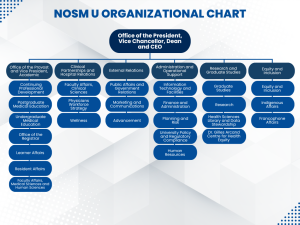
NOSM University is building strong, collaborative relationships with education, health, and community partners. Through shared initiatives and coordinated engagement, we are unlocking new opportunities in education, research, and health, together shaping a healthier, more connected North. NOSM University is committed to corporate, social, and academic accountability, and this is reflected in the University’s organizational structure. The University is registered as a not-for-profit corporation and maintains an independent budget, administration, a Board of Governors and a Senate.
NOSM University’s bicameral governance structure is comprised of the Board of Governors and the Senate. The powers of both governance bodies derive from the NOSM University Act. The University Secretary administers the governance of the University by supporting the Board of Governors and Senate and their committees. Senate is the university’s most senior academic body. Representing the NOSM University community, Senate comprises over 80 members, including faculty, students, senior administration, and 2 externally appointed representatives from another Ontario University. Senate makes decisions of significant importance to students and faculty, including awarding degrees and scholarships, approving new programs and revised curriculum, and establishing academic regulations.
The Executive Group (EG) is the senior strategic administrative body for overseeing operational and academic matters within NOSM University. EG was established to share information and provide advice to the President on major strategic, academic, and operational matters for NOSM University, including the annual planning cycle, corporate priorities, key performance indicators, and budget & workforce planning. The Executive Group consists of the President, Vice Chancellor, Dean and CEO, the Provost and Vice President Academic, the Vice President, Clinical Partnerships and Hospital Relations, the Vice President of Research and Graduate Studies, and the Vice President, Chief Administration Officer.
The Senior Leadership Group (SLG) is the senior administrative body established to provide Executive Group (EG) with guidance and advice on all operational and academic matters within NOSM University. SLG is comprised of the 5 members of the Executive Group, along with the Associate Vice President of Finance and Administration, the Associate Vice President of Research and Graduate Studies Administration, the Associate Vice President of Equity & Inclusion, the Associate Vice President of External Relations, all Associate Deans, the Registrar and the University Secretary. SLG observers also include Directors from across the University.
Section 20: Unit Specific Information, Resources, and Links
Note: To access some of the following resources and links, you will be required to use your MyNOSM credentials and password.
Office of the President, Vice Chancellor, Dean and CEO
Executive Group and Senior Leadership Group
Office of the Provost and Vice Dean, Academic
Office of the Vice President, Administration and Chief Operating Officer
Policies, Protocols and Procedures
Employment Equity and Diversity
Information Technology (IT Helpdesk, Password Management and Training Resources)
Program Director and Postgraduate Medical Education Faculty Leadership Resources
PGME Family Medicine Faculty Handbook 2021-22
Continuing Professional Development
Health Sciences Library-Health Sciences Information, Services, Resources and Research Support
Contact and Campus Locations
NOSM University operates across Northern Ontario with campuses in Thunder Bay and Sudbury and partnerships with communities throughout the region.
Connect with our team:
Clinical Sciences Division – divclinsci@nosm.ca
Human Science Division – humscidiv@nosm.ca
Medical Sciences Division – medscidiv@nosm.ca
General
Email: faculty@nosm.ca
Faculty Toll-Free Helpline 1-877-678-7358
If you reach the voicemail, please leave a message with your name and preferred contact information. Your call will be returned within 48 hours.
NOSM University in Thunder Bay
955 Oliver Rd | Thunder Bay, ON | P7B 5E1 | Tel: 807-766-7300 | Fax: 705-662-7265
NOSM University in Sudbury
935 Ramsey Lake Rd. | Sudbury, ON | P3E 2C6 | Tel: 705-675-4883 | Fax: 705-662-7265