With snow, wind, and all the challenges associated with it now here, I have to ask: Are you ready for winter? The ten-foot snowbanks, the blizzards, the -38 oC with wind chill, the bad roads, and all the other elements of winter that we would rather not even think about. What is your state of readiness for winter? Like it or not, winter is coming!
Are your winter clothes in good shape? Check. The furnace is in good working order? Check. Got the winter tires on? Check.
Personally, I’ve always been comforted by winter and welcomed it. There’s nothing quite like the beauty and stillness after the first snowfall when the landscape is transformed overnight into a winter wonderland. The Northern experience of winter brings out the child in me more than any other season. To me, winter is a time of believing; a time of joy, magic, laughter, snowiness, togetherness, and in our case at NOSM—soon to be NOSM University—it is a time for readiness.
How can we be ready for change? That’s the fundamental question NOSM leaders ask themselves as they prepare for the future. It comes at a time when we face many external variables: a global pandemic, health human resource shortages, complex Northern health issues, and the Laurentian University insolvency. Readying ourselves has never felt more urgent.
The most useful tool of readiness for NOSM University is scenario planning which includes the following stages:
- Trying to predict the timing of proclamation and the immediate changes needed to prepare for the issuance of degrees for the MD undergraduate and Master of Medical Studies programs with our first Convocation ceremony in May 2022.
- Making sure we have the right people in new roles to get the work done including registration, tuition, and credit transfers to ensure a seamless transition for our students.
- Maintaining joint faculty appointments, research grant administration, research ethics boards, graduate student supervision, services, leases, and the properties that we share with Laurentian and Lakehead Universities.
- Communicating with stakeholders about the processes for a new Board of Governors, Senate and an inaugural Chancellor, and
- Fundraising for bursaries, endowments and projects desperately needed to support our work as the first ever free-standing medical University in Canada.
In thinking about how NOSM University will grow, we are imagining a variety of plausible future scenarios and we are considering new models to devise new strategies.
With readiness and developing an exciting future in mind, the second and third legs of my NOSM Consultations have been completed. Our teams spent time hearing the voices of community members in Thunder Bay, Sioux Lookout, Kenora, Fort Frances, Hearst, Kapuskasing, Sudbury, Sturgeon Falls, North Bay, Temiskaming Shores, Timmins, Sault Ste. Marie, Parry Sound, Huntsville, Rosseau and Manitoulin Island. Once again, these consultations are the tip of the iceberg of ongoing discussions that have also included committees, key informants, learners, faculty, and the public.
NOSM University Consultations have resulted in:
- 519 survey responses
- 11 town hall consultations in Northern Ontario communities
- 600 persons who have attended presentations
- 50+ key informant interviews
- 1260 people consulted either in person or virtually
What we know is that our state of readiness to become a university includes the expansion of our Undergraduate Medical Education (UME) and Postgraduate Medical Education programs (PGME); the evolution and regionalization of a focussed network of campuses; and the emerging emphasis on research in population health, is in good shape.
Just like getting ready for winter, there is preparation that comes with becoming Canada’s first stand-alone, degree granting medical university. We have established an Office of the Registrar and integrated Learner Support Services. We are exploring the best models for research administration and building ongoing dialogue with Laurentian University and Lakehead University. We are planning for a possible ‘first’ convocation for NOSM University degree recipients and launching searches for a new Board of Governors and for an inaugural Chancellor. There is so much to do.
As we plan and prepare, we cannot pre-empt government and cabinet or be certain until we hear Proclamation of the NOSM University Act. We are proceeding ‘in principle’ and in a state of preparedness. Though there is much work to do, we will make sure that the transition from NOSM to NOSM University will not negatively disrupt your learning or work life.
Our PGME Residency programs are breathing again, having been through a rigorous week of accreditation by the College of Family Physicians of Canada and the Royal College of Physicians and Surgeons of Canada. BRAVO and BRAVA to Dr. Anderson, Ms. Fawcett, Ms. Giusti, the Program Directors, Program Coordinators, PGME Office staff and everyone who contributed to this important review. Although not yet official, and subject to the confirmation of the two Colleges, it is great news that all our programs are recommended for full accreditation with some requiring follow up reviews in the future. This is a wonderful result.
Miigwetch, thank you, marsi, merci,
Dr. Sarita Verma
Dean, President and CEO
Northern Ontario School of Medicine
If you have any feedback or comments, please reach out at dean@nosm.ca and follow me on twitter @ddsv3.
 Notice to the Upcoming NOSM Board of Directors Meeting
Board of Directors Board Sessions and Open Meeting
Thursday, December 2, 2021
Board sessions will be held throughout the day with an open meeting beginning at 1:15 p.m. For more details or to attend, please contact governance@nosm.ca.
 Celebrate this Giving Tuesday
Giving Tuesday is a simple idea—it’s a day to contribute and to do good. This Giving Tuesday, make a difference right here at NOSM. With 90 percent of NOSM medical students in the MD Program applying for financial aid, it’s an opportunity to offer your support. Honour the memory of a colleague with a gift to one of our established memorial funds or consider making an end-of-year contribution to the Student Emergency Fund.
Double your impact! This year community partners MNP and Tbaytel are generously supporting our medical students. MNP is matching funds up to $5000 for the Student Emergency Fund and Tbaytel is matching funds up to $10,000 for the Tbaytel Entrance Award Fund—a new scholarship for medical students from northern Ontario.
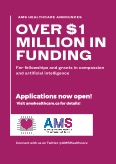 Apply for 2022 AMS Fellowships and Grants in Compassion and Technology
Does your work help answer the question, “How can digital technology and artificial intelligence change the health care we provide?”
If you are early to mid-career and hold a PhD or a Master’s degree, you are eligible to apply for AMS healthcare funding in compassion and Artificial Intelligence (AI). Fellowships are $75,000 for one year, with no requirement for matched funding. The grants are $20,000 each. Please visit AMS 2022 Funding Opportunities for more information.

Whole School Update, 2021: A Year in Review
Everyone is invited to join the upcoming Whole School Update hosted by Dr. Verma.
Join us for an update about plans for NOSM University and a glance at the NOSM year in review.
Friday, December 17, 2021 | 8:30 a.m. – 9:00 a.m. | Via WebEx
Join by phone: 1-855-699-3239 | Access code: 242 204 49855
NOSM Staff and Faculty Holiday Check Up
Attention NOSM staff and faculty! Bring your favourite warm beverage and sit down to share some fun festive virtual activities with your friends and coworkers.
Friday, December 17, 2021
9:00 a.m. – 10:00 a.m. (Following the Whole School Update) | Via WebEx
Join by phone: 1-855-699-3239 | Access code: 242 084 98924
Celebrating a NOSM Competence by Design Innovator
Dr. Jane Fogolin, NOSM Assistant Professor, Psychiatry in Thunder Bay, has been nominated as a Royal College Competence by Design (CBD) Innovator. The CBD Innovators are a group of 24 program directors and leads across Canada who are responsible for implementing CBD at their respective medical schools across Canada. Nominated by their peers for demonstrating innovative ideas in their programs. Previous CBD Innovators include NOSM faculty members
Drs. Angèle Brabant-Trottier and Amy Nistico.

Attention NOSM MD Students, Residents and Learners:
Join an upcoming NOSM Psychiatry Information Night
Did you know that the NOSM Psychiatry Residency Program has home-base learning sites in Thunder Bay, Sault Ste. Marie, North Bay, and more?
Ask questions and learn more from the Program Director, current residents, site directors, and academic and psychotherapy coordinators of the program.
Please register in advance at psychiatry@nosm.ca. Choose from this, or other upcoming Psychiatry information sessions to be held on
December 7 and 16, 2021, and January 5 and 12, 2022.
Attend a NOSM Public Health and Preventive Medicine (PHPM) Information Session
There are many new, innovative opportunities happening in public health these days. It’s an opportune time to learn more about the NOSM PHPM Program.
Program leaders, faculty, and residents will present details of the program and answer your questions.
Sunday, December 12, 2021
3:00 p.m. – 5:00 p.m.
Details about the NOSM PHPM Program will be provided by program leadership and faculty. Please RSVP by Friday, December 3, 2021. WebEx details will be provided.