
Francophone faculty at the Northern Ontario School of Medicine (NOSM) come from diverse French-speaking backgrounds and they take great pride in practising medicine in French. With March being Francophonie Month, hear the voices of a few Francophone faculty as they reflect on their unique experiences treating the growing community of Francophone newcomers, immigrants, refugees, and Franco-Ontarian seniors and children in Northern Ontario.
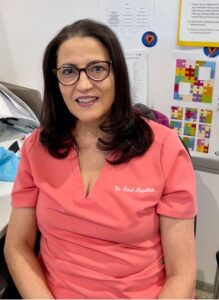
Dr. Amel Abdallah
Dr. Amel Abdallah is a NOSM Assistant Professor and a family physician at Fort William Family Health Team in Thunder Bay who speaks French, Arabic, and English. She attended medical school in Tunisia in French before relocating to Canada. After completing her rural family medicine residency in Alberta, Dr. Abdallah started her practice in Thunder Bay.
“I am originally from Tunisia, North Africa. Like other French colonies, we learned French in elementary school where I studied formal French. I immigrated to Canada in 1985 and lived in Montréal, where I became familiar with Québécois French,” says Dr. Abdallah. “I feel fortunate to have a good knowledge of various French dialects and accents.”
Dr. Abdallah says she did not speak any English when she relocated to Thunder Bay, but recalls connecting immediately with the Francophone community through the Association des francophones du nord-ouest de Ontario (AFNOO) for support.
“I made friends with Francophone people in Thunder Bay and my children attended French immersion,” Dr. Abdallah says. She also has family living in France and Belgium which lends to her knowledge of several French dialects. The diversity is useful in her medical practice. She recalls the story of a Francophone mother who came into the clinic with a sensitive medical issue, however wanted her teenage son with her to translate.
“She was so happy that I spoke French as she had some genitourinary symptoms and was not comfortable bringing them up in front of her son. She was very happy to have me address her concerns in French while maintaining her privacy,” says Dr. Abdallah. “I’ve also provided obstetric care to French-speaking patients in labour and delivery. It is much easier to communicate when you can speak the person’s language, and can understand information provided to you and relay it to everyone involved in their care.”
Dr. Abdallah says understanding the importance of communicating with French patients is a value that is supported and instilled at NOSM. “I commend NOSM for providing a great opportunity to medical students to practice interviews in French with the ‘séances d’aptitudes cliniques’,” says Dr. Abdallah.
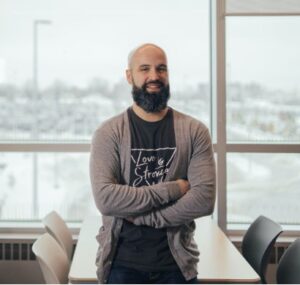
Dr. Alex Anawati
“I’ve noticed that there are more and more people who call Canada their home, having recently immigrated here with French as their first language. Francophones frequently express relief at being able to speak French to share their health concerns,” says Dr. Alex Anawati, NOSM alumnus (MD 2009) Associate Professor and Global Health Coordinator, and Emergency Physician at Health Sciences North (HSN) in Sudbury.
Dr. Anawati is Francophone, originally from Sturgeon Falls with international French roots. “I speak Canadian, Northern Ontarian French, with some influences from my father, who learned French in Egypt. My mother grew up in North Bay and also speaks French. We have family in France and Québec and all of these influences have helped keep my Francophone routes alive and well, and diverse,” he says.
“The diversity of vocabulary and language grows the more you use it and the more you listen; whether I’m speaking with Franco Northern Ontarians, recent immigrants, or with my Francophone family members and friends from Canada and all over the world.”
Speaking French every day in the Emergency Department at HSN, Dr. Anawati practices Active Offer—a proven best-practice method used to improve health-care delivery to Francophones by making a point of offering to speak French first. He also speaks French routinely with colleagues.
“I speak French with consultants and with other health-care team members. In fact, I very much enjoy the opportunity to speak French with Francophone nurses, physicians, administrators, and stakeholders,” he says. “I’m continually expanding and learning new medical vocabulary.”
“I think that the words we choose and the language we use to express ourselves matters a lot. A rich vocabulary and creative articulation of ideas and thoughts can be inspirational. I am always looking to expand my vocabulary and discover creative ways to connect to people through words and language at the point of care and through advocacy work,” says Dr. Anawati.
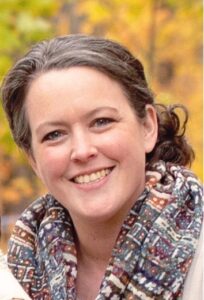
Dr. Meghan Cusack
“I speak a mish-mash of Northern Ontario/Sudbury French, with some Ottawa influence from my 10 years spent there for my post-secondary education,” says Dr. Meghan Cusack, NOSM Assistant Professor.
“My Francophone roots are deep in Northern Ontario with my relatives coming from Québec to settle in Valley East several generations ago,” she explains. “I only speak French with my children now, as the Francophone members of my family have all passed or moved away. We are working at sustaining our Franco-Ontarian culture together.
Dr. Cusack says Francophone elderly, immigrants, and children from Francophone homes are those who rely most on the linguistic sensitivity of spoken French. “They may understand English to some extent, but as one patient told me ‘When I’m sick, I’m sick in French.’”
“There are numerous instances where Francophone patients encounter unsafe care due to linguistic insensitivity. It is my goal to educate medical students at all levels to ensure we avoid these patient pitfalls at all costs.” Dr. Cusack believes NOSM’s mandate to advance social accountability and its commitment to advances in models of health-care delivery in Francophone, Indigenous, rural and remote areas is unique and necessary.
“There are very few medical institutions that have a mandate of improving care for the minority Franco-Ontarian community. NOSM has recently been expanding its efforts to support Francophone and Francophile learners, in addition to supporting anglophones in recognising and providing linguistic and culturally sensitive care. There is still room for improvement, but I’m encouraged to see the efforts continue through the years,” Dr. Cusack says.
“I am so very proud of the students that I’ve worked with over my years as Undergraduate Francophone Clinical Lead. They have demonstrated incredible resiliency, engagement and passion as they trained to better serve our Francophone community,” says Dr. Cusack. “I look forward to seeing our efforts to bring more Francophone content to the core curriculum, as we continue our advocacy in our health-care communities to ensure linguistic and cultural safety for all patients.”
 You’re Invited