I am frequently asked—in the grocery store, by email, in DMs on social media—“Why didn’t my child or cousin or neighbour get into NOSM University?”
The journey to becoming a physician is a competitive, complex and challenging one. It is a passage that few people truly understand or appreciate. I hope to offer some insight into the process.
Typically, Canadian citizens finish high school, then finish a university degree (in most cases) and then they apply to medical school. There are 17 medical schools in Canada, of which NOSM University is the only fully independent medical university. Acceptance to all of them is highly competitive and very selective.
The acceptance rate for NOSM University’s MD program is currently three to four per cent. That’s because we receive roughly 2,000 applications for only 74 spots that are split between our Sudbury and Thunder Bay locations. There are no positions allocated for international students at present as, by provincial directive and University policy, all positions are reserved for Canadian citizens or permanent residents.
With our recently announced upcoming expansion, we expect to increase our MD program intake over the next three years to 99 spots per year. We expect that application rates will also rise, but for that very reason, I also expect that the success rates may not change. We also work in partnership with the Department of National Defense to offer up to five Military Medical Training Program (MMTP) seats.
The main limiting factor to an eligible applicant hearing “yes” is—truly—the number of available seats. Applicants are generally of a very high quality, but the bottom line is that admissions are extraordinarily competitive, and the difference between candidates may be a hair’s breadth.
Much depends on the admission criteria of the specific school or university. Canadian schools use various methods of determining academic abilities, such as a university grade point average (GPA)—a summary statistic of academic performance. GPA is probably one of the few tools available to measure an applicant’s academic abilities. A mediocre or low GPA despite the adjustments makes it very difficult to succeed in a competitive field.
Some institutions still rely heavily on the MCAT (Medical College Admissions Test), though NOSM University does not. The MCAT—a tool available only in English—is considered by some to be a significant and unfair barrier to applicants from lower socio-economic backgrounds or differing cultural backgrounds, including Indigenous and Francophone applicants. NOSM University students perform brilliantly on the Medical Council of Canada exams, which we believe demonstrates that, regardless of the MCAT, we graduate competent physicians.
Upon admission to most medical schools, there begins a rigorous four-year program requiring that huge amounts of knowledge, skill, and professional attributes be acquired. These years are hard. Students learn in diverse settings, and at NOSM University, these are mostly in community-based environments. This is something for which we are renowned, and the reason why NOSM University alumni are so successful.
This is labour intensive and relies heavily on teachers—mostly practising physicians—across the region. Students learn foundational science and clinical topics to prepare for the workplace learning that happens in the final two years of the program, known as clerkship. That is where medical students spend time living in Northern communities while learning about family medicine, surgery, obstetrics, pediatrics, psychiatry and more.
These are years of building resilience in preparation for the transition to residency training, which itself only happens after a national matching process wherein they compete for residency spots—another highly competitive and stressful process. And they must pass the Medical Council of Canada Qualifying Examinations (MCCQE 1) to go on to licensure.
Residency training is two years for family physicians and specialty training takes up to five years, and it is often longer for subspecialities. On top of this, some stay on for one or two years to do fellowships for extra training in special areas.
I’ll add this up: four years of pre-med, plus four years of MD education, plus two years for family medicine. That’s give-or-take 10 years to become a practising family physician. For a specialist, that number jumps to 13 to 18 years.
Becoming a doctor is a massive personal and societal investment.
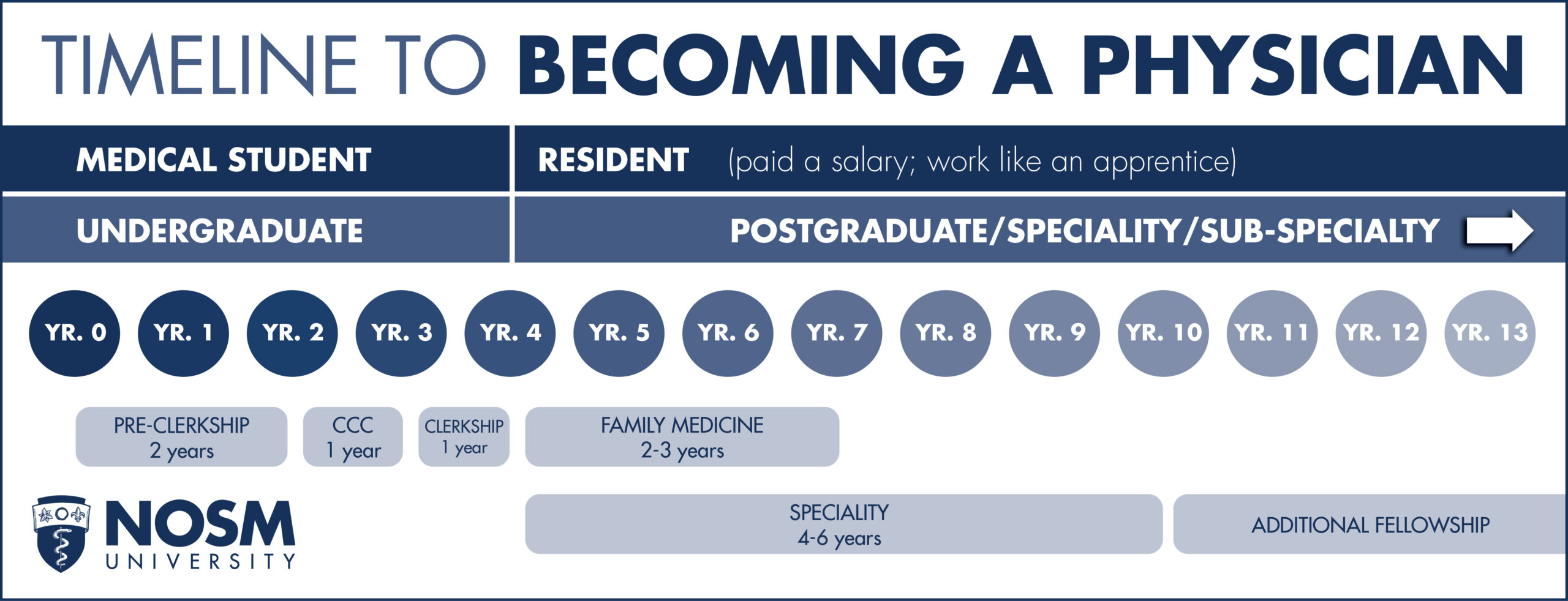
This chart is fairly basic and does not reflect that during these years, life also happens. The length of time it takes to enter the workforce as a physician is influenced by time out for maternity/parental leaves, scientific training such as completing a PhD, the choice of one’s residency and location of practice.
The journey to becoming a practising physician is long and the road is unpredictable. Many factors influence what kind of doctor to become, and where to live and work. For those wishing to become doctors, this is a life-long investment, and the stakes are high. Supporting students on their paths (as well as our faculty who give much of their time as clinical role models) is critical.
We celebrate the efforts of all applicants, their families, teachers, staff and community volunteers as we make our selections. On behalf of everyone at NOSM University, I want to acknowledge the hard work that goes into making this institution a success for Northern Ontario.
Dr. Sarita Verma
President, Vice Chancellor, Dean and CEO
NOSM University
If you have any feedback or comments, please reach out at president@nosm.caand follow me on Twitter @ddsv3.
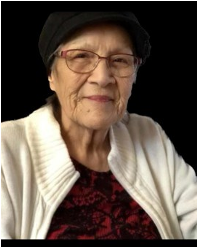
It is with greatest sadness that we learned of the passing of Elder Eleanor Pine. I had the great honor to meet her in 2020. Eleanor was a beloved Elder of the NOSM University community, and a strong and wise spirit. Her bravery and honesty guided many on their learning journeys.
Eleanor led Knowledge Sharing Circles at the University, and taught many learners in Sagamok on their Indigenous community placements. We at NOSM University were blessed to know her. Chi miigwetch to Eleanor and her family for their leadership and kindness.
Our thoughts are with the Pine family.
Northern Lights: Registration Now Open
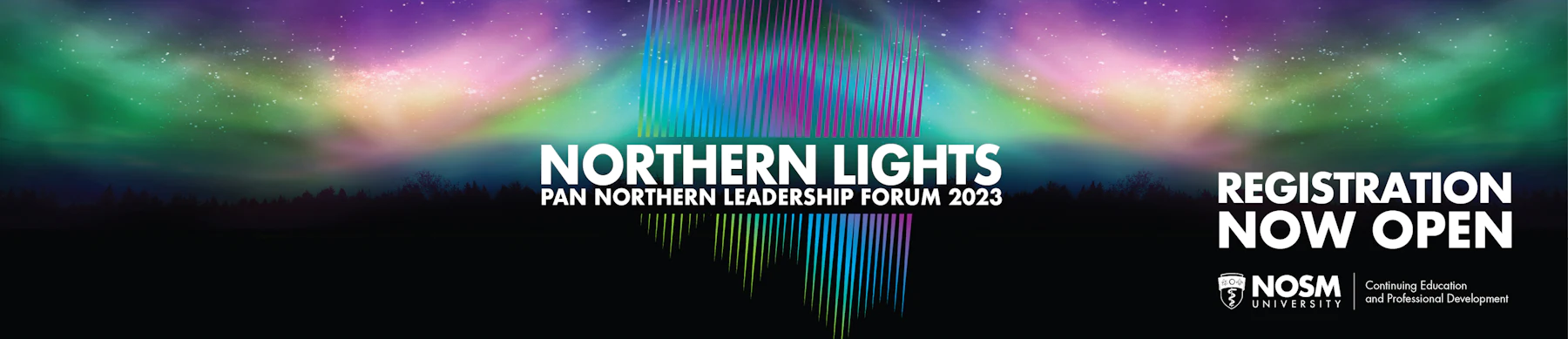
Join us virtually on March 2-3, 2023 for our annual Pan Northern Leadership Forum. Learn with, and from, colleagues across Northern Ontario. Sessions will be relevant to faculty in their first five years of practice along with developing and experienced leaders.
To register, please visit the Northern Lights webpage.
Northern Constellations

NOSM University’s annual Faculty Development conference, Northern Constellations, will be held in-person on May 5-6, 2023 in Thunder Bay. Our exceptional keynote speakers are Danielle Daniel and Dr. James Maskalyk.
Learn more on the Northern Constellations webpage.

Interviews for applicants to NOSM University’s MD Program will take place virtually on March 4-5, 2023. I wish all candidates the best of luck.
NOSM University Achievement Celebration

The achievements of the people of NOSM University in 2022 were unprecedented. To celebrate the extraordinary contributions of faculty and learners, as well as to introduce new alumni awards, we will be hosting the first NOSM University Achievement Celebration the evening of Friday, May 5, 2023. A highlight of the evening will be the keynote address by Dr. James Goertzen as he retires and reflects on his own journey, and that of education in the North, over the last three decades. Stay tuned for more details.
We’re Hiring
NOSM University is seeking its next Associate Dean, Continuing Education and Professional Development (CEPD). 
This role provides ongoing leadership for the program, with core responsibilities in leading CEPD strategic planning, developing innovative approaches to continuing education and professional development for faculty physicians and other health-care professionals, and expanding on the existing MD and residency programs, consistent with the NOSM University strategic priorities and academic principles.
Learn more at nosm.ca/careers.

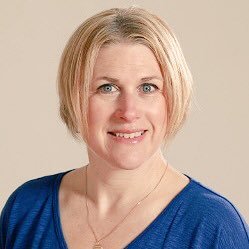 It is with great pleasure that I announce the appointment of Dr. Céline Larivière as the first Provost of NOSM University. Dr. Larivière is a Laurentian Alumna and has a long-standing interest in the area of exercise science and human physiology. She pursued doctoral studies in Physiology at the University of Ottawa between 1994 and 1999 then completed post-doctoral training for a period of two years at the Ottawa Hospital Research Institute. She has extensive administrative and educational leadership. While at Laurentian University, she served as the Dean of the Faculty of Health from 2017 to 2021 and the Dean of the Faculty of Education and Health between 2021 and 2022. She also briefly served as Interim Provost and Vice President, Academic (2022), was the Vice-Dean Francophone Affairs of the Faculty of Professional Schools (2003-2005), the Interim Director of Research (2011), and the Director of the School of Human Kinetics (2012-2017).