
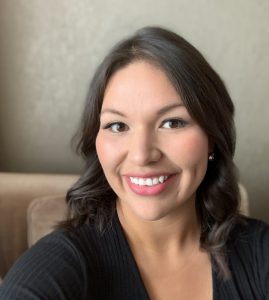
Dr. Rebekah Neckoway, NOSM alumna (MD 2013), is no stranger to both the challenges and rewards of working in the North. Based in Sioux Lookout for work, she spends her time travelling to Northern fly-in communities where she is often one of the only physicians providing care. She’s practiced as far north as Fort Severn on the Hudson Bay coast.
It’s a grueling schedule with a lot of travel, but Dr. Neckoway says the keys to achieving balance in her life are maintaining relationships and taking scheduled breaks.
“I think the key to decompressing is chatting things through with people you trust,” she explains. “Sometimes it is with my medical school colleagues, other times it is with more experienced physicians in my practice, or with people I trust.”
“Most people will tell you about the successes, but it’s hard to talk about the failures. And yet, when we do, it makes us feel like we’re not alone. I think the greatest relief is when someone says they’ve been in that situation too, and shares how they handled it,” says Dr. Neckoway.
She and her NOSM graduating class have prioritized annual ski trips together since they started medical school in 2009. In 2019, they marked their 10th trip together, celebrating by travelling to the Austrian Alps.
She and six fellow NOSM alumni went on the trip, including: Dr. Katie Murphy, a pediatrician in Thunder Bay; Dr. Caitlin McCallum, an intensivist at Thunder Bay Regional Health Sciences Centre; Dr. Justin Poling, a general surgeon in Sioux Lookout; Dr. Andrew Ross, a locum in and around the Sioux Lookout region who also works rural southern Ontario and Thunder Bay; Dr. Giuseppe Valente, an orthopedic surgeon in Toronto; and, Dr. Calen Sacevich, an anesthesiologist.
“It was epic,” Dr. Neckoway says. “When you consider that I learned to snowboard in my second year of medical school and now the group has travelled to the Alps, Whistler, Tremblant, Banff, and Revelstoke. A special thanks to Dr. Ross for keeping us inspired and being the mastermind behind the trip planning.”
Dr. Neckoway says for her, the trips were more than just a getaway. They were a chance for the group to reconnect, have fun and to talk more deeply about their work challenges.
“It is really nice to know that we’re all trudging through this stuff together,” says Dr. Neckoway. “We all went through medical school together, then navigated residency, work opportunities and our personal lives, including relationships and children.”
“I find that the longer we’re with each other, the more we can step back and admit ‘I’m struggling a little with this.’ When the guard comes down, we’re able to chat more about it. The time away
together allows us to share from a very real place. It is good to know we’re not alone,” Dr. Neckoway says.
The trips became a personal reminder to prioritize balance in her life, as Dr. Neckoway says travel brings joy and a sense of feeling refreshed. The biggest challenge was giving herself permission to take a break.
“There needs to be balance, and balance across the profession. For me, that means doing the things I love. I love to travel and I’ve been to 30 countries. I love Ireland. I recently went there for three months and took a break from medicine. For a few months, I was an au pair on a sheep farm with two kids. I also worked on an oyster farm for two weeks. I did all of that for me,” says Dr. Neckoway.
“Now coming back to work after three and a half months off, I have this new invigoration and new joy again to practice medicine,” she explains. “I needed to take a break, but after a while I realized I missed those challenging cases and that higher level of planning and thinking that goes into medicine. I was happy to know I could come back to it.”
The break reinspired her to practice. She says it also revealed a new found ambition to do more in the areas of health advocacy and health policy. Balance is allowing her to avoid burnout and achieve career longevity.
“In medicine, sometimes we feel this pressure to be working hard, pulling those long hours that we did in residency. I feel that I am living bravely by taking this time for myself and giving myself permission. The work-life balance will sustain me well into my 60s by preserving and protecting my own wellness. I think this is a message that needs to be widely shared.”
Dr. Neckoway paraphrases a quote by author Shannon Tanner: “For those who struggle with guilt regarding self-care, answer this question: ‘What greater gift can you give those you love than your own wholeness?”