Bienvenue dans le nouveau site Web de l’EMNO. Même si nous sommes en train de créer un site complètement bilingue, veuillez noter que seulement certaines pages existent en français en ce moment.
NOSM University announces the appointment of Dr. Marjolaine Talbot-Lemaire as the inaugural Postgraduate Medical Education (PGME) Learning and Assessment Lead, effective July 1, 2026.
Dr. Talbot-Lemaire brings more than a decade of experience in medical education, clinical supervision, and academic leadership. A family physician in Hearst and an Associate Professor at NOSM University, Dr. Talbot-Lemaire has a strong commitment to competency-based, learner-centered assessment and supporting medical residents, including those requiring remediation.
In this role, she will support residency programs, faculty, and learners by advancing assessment practices, contributing to faculty development, strengthening systems that support learner success, and leading the development of remediation processes and enhanced learning plans.
A new pathway will support occupational therapy, physiotherapy, and speech-language pathology students
with placements, housing, and relocation support in Northern Ontario.
McMaster University’s School of Rehabilitation Science and NOSM University are launching a new pathway that will help rehabilitation sciences students from Northern Ontario train closer to home and build careers in the region.
The Northern Practice Pathway builds on a long-standing partnership between the two universities and responds to ongoing shortages in rehabilitation services across Northern Ontario. The pathway will support students in occupational therapy, physiotherapy, and speech-language pathology through clinical placements in the North, housing during placements, and relocation support.
For many learners, clinical placements are where careers are rooted. By making it easier for students from Northern Ontario to complete placements in the North, the pathway is intended to strengthen the connection between education, local practice, and long-term recruitment.
“When learners are supported to train in Northern communities, they gain first-hand experience with the unique strengths, health-care needs, and realities of practising in the region. Those experiences shape the health professionals they become and strengthen the connections that encourage them to build their careers in Northern Ontario,” says Dr. Céline Larivière, Provost and Vice-President, Academic at NOSM University. “This partnership reflects the power of long-term collaboration to improve access to care across Northern Ontario.”
“Northern Ontario has a high rate of job vacancies in rehabilitation sciences,” says Dr. Mike Ravenek, Director, Health Sciences and Program Development at NOSM University. “The Northern Practice Pathway will help NOSM University effectively serve learners and communities as we work to respond to the unique health challenges and evolving needs of the region.”
Support is provided through existing funding from the Ontario Ministry of Health. Students selected for the pathway will complete most of their clinical placements in Northern Ontario. They will also receive support for travel and relocation costs, secured accommodations for the duration of their northern clinical rotations, and dedicated educational opportunities that focus on the understanding of Indigenous and Francophone health and responsive care.
“The Northern Practice Pathway is a practical response to rehabilitation needs across the region,” says Dr. Sarah Wojkowski, Vice-Dean, Health Sciences and Executive Director, School of Rehabilitation Science at McMaster University. “By using existing provincial support in a focused way, we can reduce some of the barriers students face and help them build the relationships, skills, and confidence to practise in the North after graduation.”
Each year, the pathway will be available to up to six occupational therapy students, six physiotherapy students, and two speech-language pathology students. Prospective students can learn more about the pathway on the McMaster School of Rehabilitation Science website.
-30-
About NOSM University
NOSM University is Canada’s first independent medical university and one of the greatest education and physician workforce strategy success stories of Northern Ontario. More than just a medical university, it was purpose-built to address the health needs of the region. While advocating for equitable access to care, the university contributes to the economic development of Northern Ontario. NOSM University relies on the commitment and expertise of the people of Northern Ontario to educate health- care professionals to practise in Indigenous, Francophone, rural, remote, and underserved communities. With a focus on diversity, inclusion, and advocacy, NOSM University is an award-winning, socially accountable organization renowned for its innovative model of distributed, community-engaged education and research.
For further information, please contact news@nosm.ca.
About McMaster University
McMaster is a research-intensive university ranked among the best in the world with a bold ambition to advance human and societal health and well-being. Among Canada’s top universities for student services, our research excellence is matched by our long history of teaching innovations and commitment to preparing students for an increasingly complex future. Our alumni continue to be among the most employable graduates globally, as they bring the McMaster vision of a brighter world to communities near and far.
For 20 years, NOSM University’s CampMed has inspired high-school students to choose careers in health care. Designed for youth from Northern, rural, and remote parts of Ontario, the annual summer camp gives grades 10 and 11 students a hands-on preview of careers in a variety of health-care fields and medical specialties. This year, CampMed takes place July 6-10 in Sudbury and July 13-17 in Thunder Bay.
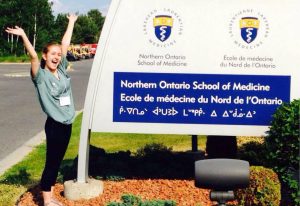
“My time at CampMed reinforced my passion for medicine and set me up for a lifelong career in health care,” says Dr. Alyssa Labelle, who is from Sudbury. A previous camper and volunteer at CampMed, Dr. Labelle went on to graduate from NOSM University’s MD program and is currently an Obstetrics and Gynecology resident at Dalhousie University.
Her advice to high-school students? “To anyone with a dream that feels bigger than yourself—work hard, be kind to others, and don’t forget to cheer yourself on along the way! You’ve got this!”
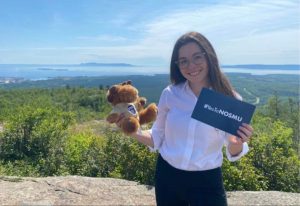
CampMed also played a major role in the health-care journey of Dr. Claire Poulin, who is from Atikokan. “Coming from a small community, I only saw a fraction of the allied health-care careers that exist. My experience at CampMed opened my eyes to the various medical specialties that doctors can pursue, and how physicians work in partnership with other health-care providers to optimize each patient interaction,” she says.
Now specializing in family medicine, Dr. Poulin is a first-year NOSM University medical resident in Thunder Bay. Like Dr. Labelle, she attended CampMed as a camper in high school and a volunteer while pursuing her undergraduate and MD degrees.
“I hope students from other small towns across the North will see that just because you aren’t from a city doesn’t mean you can’t chase your dreams,” Dr. Poulin says. “I hope students from other small communities across the North know that where you come from doesn’t define how far you can go. Your dreams are within reach.”
Many campers are inspired to pursue careers as physicians or other health-care professionals after attending CampMed, though it does not increase the chances of admission to their program of choice. CampMed provides students with an opportunity to obtain hands-on experience and explore Indigenous and Francophone cultures, health and traditions, and health-care careers.
At the age of 15 or 16, campers also connect with mentors and potential future colleagues. These early connections are an important source of peer and mentor support throughout campers’ future careers in health-care fields. Fifty-two campers and 57 volunteers have gone on to complete the MD program at NOSM University.
In the context of medical careers, which require at least ten years of post-secondary education, the relationships built during CampMed can be particularly poignant. “It has been more than ten years since my experience at CampMed, and I still keep in touch with so many people I met along the way,” says Dr. Labelle. “Medical student mentors at camp became attending physicians when I was in medical school, and now colleagues. Many of my fellow campers either became my medical school classmates or other colleagues in health care, such as nurses or dietitians.”
NOSM University is deeply rooted in the communities of Northern Ontario and in improving the experiences of Northern, Indigenous, Francophone, and rural learners—beginning with recruitment. As CampMed marks its 20th anniversary, NOSM University celebrates the more than 1,200 campers, 300 volunteers, and generous donors whose commitment, enthusiasm, and support have helped inspire the next generation of health-care professionals.
“For 20 years, CampMed has helped young people from Northern Ontario see themselves in health-care careers they may never have imagined possible,” says Dr. Michael Green, NOSM University President, Vice-Chancellor, Dean, and CEO. “By creating opportunities for students to explore medicine and other health professions while connecting them with mentors, communities, and one another, CampMed is helping build the future health workforce our region needs.”
Alyssa Labelle attends CampMed as a camper in 2015.On Mount McKay (Anemki Wajiw), Claire Poulin takes a photo to mark that she has chosen NOSM University’s MD program, 2022.