
Medical Learners Choose to Stay in the North, Thanks to Rural Pathway
Posted on September 23, 2026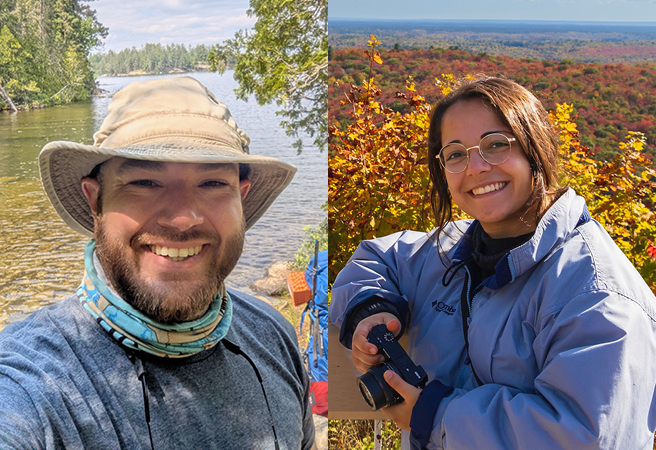
NOSM University’s Rural Generalist Pathway was designed to shore up Northern Ontario’s physician workforce. Now in its fifth year, the initiative supports doctors as they train for rural practice.
Both Eric Grimm, a third-year MD student, and Dr. Tiana Bressan, a first-year medical resident, were influenced to choose NOSM University because the pathway would support and prepare them for careers as rural generalists.
“My interest in rural practice absolutely influenced my decision to choose NOSM University,” says Dr. Bressan. “NOSM University was one of the only schools where I could spend a significant portion of my training in the kinds of communities where I ultimately hope to work, including remote and underserved settings, while remaining close to home.”
“I chose NOSM University because the training is specifically useful for people like me who want to pursue rural generalist medicine,” says Grimm.
Research shows that medical students and residents are more likely to work where they have trained. Learners who have positive rural clinical experiences and rural longitudinal clerkships are more likely to choose rural practice as part of their career path.
For both learners, the desire to practise rural medicine started in their own backyards.
“Living in Kenora, I felt and witnessed the impact of a stressed local health-care system,” says Grimm. “I realized that I wanted to pursue my dream of working as a physician in Kenora or another rural community. It is very appealing to be able to work in a small town and positively affect the health of so many community members,” he continues. Originally from rural southern Ontario, Grimm’s former career took him to Kenora, where he lived for seven years and fell in love with the small city—and the North—before he applied for medical school.
From Sault Ste. Marie, Dr. Bressan was led to rural medicine through a series of small sparks. “Before medicine, I completed an undergraduate degree in biomedical engineering, where much of my interest centered around adapting medical technology for rural, remote, and underserved settings. Over time, I came to appreciate that many of those communities exist close to home. Attending an information session about the Rural Generalist Pathway, reading Range by David Epstein, and having a rural emergency department save the life of a family member were all small nudges toward rural generalist practice,” she says.
In the Integrated Family Medicine Emergency Medicine residency program, Dr. Bressan trains in Sault Ste. Marie and across the Algoma region, where she plans to pursue a comprehensive rural practice including emergency medicine, primary care, hospitalist medicine, and low-risk obstetrics.
Supporting learners from their entry into medical school, through postgraduate training, and into their early years of clinical practice, the Rural Generalist Pathway is a curriculum enrichment that offers support for professional identity formation. As early as their first year of the MD program, learners begin to form a community of practice through the Rural Generalist Pathway small group sessions.
As part of NOSM University’s MD curriculum, a series of placements, including an Indigenous cultural placement in first year, an early clinical placement in a rural community in second year, the comprehensive community clerkship in third year, and options for rural electives, give learners a series of opportunities to envision what their career in rural medicine could look like. Throughout its medical curriculum, NOSM University centres Northern Ontario and the needs of rural communities.
Beyond placements, learners connect and network with rural physicians, have opportunities to engage in purposeful rural research, and engage in advocacy and leadership activities. Generous donor funding supports their attendance at the Society of Rural Physicians of Canada’s flagship Rural and Remote Conference. There, learners connect with rural doctors across Canada and build a sense of community with peers and rural doctors across the country.
“This conference was formative for me in understanding what rural medicine will look like as a career. It gave me physician contacts across the country who were incredibly welcoming to a learner interested in rural medicine,” Grimm says.
Grimm and Dr. Bressan both envision careers with a combination of rural generalist practice and locum work, bolstered by the training and connections that they gained at NOSM University.
“Medicine can be daunting, especially in areas where you may not have access to every resource or service,” says Dr. Bressan. “Having rural mentors in our corner, people who inspire and encourage us to grow into competent, confident, and well-rounded physicians who are also engaged in and advocate for the communities we will serve, has shaped and reinforced the vision of the physician I want to become.”