

Sujeenthar Tharmalingam, PhD
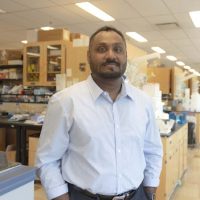
Associate Professor, Medical Sciences Division
NOSM University in Sudbury
935 Ramsey Lake Road
Sudbury, ON
P3E 2C6
Phone: 7056627149
Email: sutharmalingam@nosm.ca
Education and Professional Roles
| Assistant Dean of Research, NOSM University Associate Professor, Molecular Biology, Medical Sciences Division, NOSM University Cross-appointed Faculty Member, School of Natural Sciences, Laurentian University Affiliate Scientist, Health Sciences North Research Institute |
2016-2018 |
Post-doctoral Fellow, Radiation Biology NOSM University (Sudbury, Canada) |
2014-2015 |
Post-doctoral Fellow, Angiogenesis and Vascularisation Faculty of Health, York University (Toronto, Canada) |
2008-2013 |
PhD, Cancer Biology and Neuroscience Department of Pharmaceutical Sciences, University of Toronto (Toronto, Canada) |
2005-2008 |
B.Sc. Hons, Double Major in Human Biology and Pharmacology University of Toronto (Toronto, Canada) |
Research Interest
| My research explores cellular and molecular responses to stress across four main areas: – Cancer biology: Molecular mechanisms of resistance to radiation and chemotherapy in breast, colorectal, and cervical cancers. – Radiation biology: Mechanisms of cellular responses to radiation, including DNA damage and repair, and identification of biomarkers of radiation exposure and biological effects. – Fungal biology and diagnostics: Mechanisms of antifungal resistance and development of rapid molecular diagnostic platforms for clinical applications. – Applied microbiology: Genetic engineering of microbes for bioremediation, plastic waste management, and mitigation of metal contamination and toxicity.Model systems: Normal and cancer cell cultures, rodent models, and bacterial and fungal systems.Technical expertise: CRISPR gene editing, functional genomics, transcriptomics, epigenetics, proteomics, metabolomics, and next-generation sequencing technologies. |
| I am currently welcoming undergraduate and graduate students, research trainees, postdoctoral fellows, and research associates to join my research team. Interested applicants are encouraged to contact me at sutharmalingam@nosm.ca to discuss available opportunities and how their interests align with our research. |
Selected Publications
A full list of my publications is available on Google Scholar (https://scholar.google.com/citations?user=aH8p4cgAAAAJ). Selected examples include:
Lionel GJ, et al. (2025). Plasma miRNAome Profiling Reveals Candidate Biomarkers for Low- and High-Dose Whole-Body Ionizing Radiation Exposure. Dose-Response, 23(4), 15593258251391602.
Dickinson N, et al. (2025). Molecular Adaptations to Repeated Radiation Exposure in Triple-Negative Breast Cancer: Dysregulation of Cell Adhesion, Mitochondrial Function, and Epithelial–Mesenchymal Transition. International Journal of Molecular Sciences, 26(19), 9611.
Al-Khayyat W, et al. (2025). FRA1 (FOSL1) suppresses neoplastic transformation and modulates radiation responses via transcriptional control of mitogenic and stress-responsive networks. Frontiers in Cell and Developmental Biology, 13, 1659986.
Czajka KM, et al. (2025). Signs and symptoms of oral candidiasis associated with health factors and resistant Candida infections in a Northern Ontario patient cohort. Frontiers in Oral Health, 6, 1661524.
Slobodian MR, et al. (2025). Metabolism of Terephthalic Acid by a Novel Bacterial Consortium Produces Valuable By-Products. Microorganisms, 13(9), 2082.
Mageau E, et al. (2025). Molecular Mechanisms of Radiation Resistance in Breast Cancer: A Systematic Review of Radiosensitization Strategies. Current Issues in Molecular Biology, 47(8), 589.
Jameus A, et al. (2024). Acute Impacts of Ionizing Radiation Exposure on the Gastrointestinal Tract and Gut Microbiome in Mice. International Journal of Molecular Sciences, 25(6), 3339.
Czajka KM, et al. (2023). Molecular Mechanisms Associated with Antifungal Resistance in Pathogenic Candida Species. Cells, 12(22), 2655.
Paquette S, et al. (2023). The Effects of Oral Probiotics on Type 2 Diabetes Mellitus (T2DM): A Clinical Trial Systematic Literature Review. Nutrients, 15(21), 4690.
Al-Khayyat W, et al. (2023). Overexpression of FRA1 (FOSL1) Leads to Global Transcriptional Perturbations, Reduced Cellular Adhesion and Altered Cell Cycle Progression. Cells, 12(19), 2344.
Pirkkanen J, et al. (2023). Genomic Loss and Epigenetic Silencing of the FOSL1 Tumor Suppressor Gene in Radiation-Induced Neoplastic Transformation of Human CGL1 Cells Alters the Tumorigenic Phenotype In Vitro and In Vivo. Radiation Research, 200(1), 48–64.
Puukila, S., Tharmalingam, S., Al-Khayyat, W., Peterson, J., Hooker, A. M., Muise, S., Boreham, D. R., and Dixon, D. L. (2021) Transcriptomic Response in the Spleen after Whole-Body Low-Dose X-Ray Irradiation. Radiation research 196, 66-73
Murray, A., Tharmalingam, S., Nguyen, P., and Tai, T. C. (2021) Untargeted metabolomics reveals sex-specific differences in lipid metabolism of adult rats exposed to dexamethasone in utero. Scientific reports 11, 20342
MacLean, A., Legendre, F., Tharmalingam, S., and Appanna, V. D. (2021) Phosphate stress triggers the conversion of glycerol into l-carnitine in Pseudomonas fluorescens. Microbiological research 253, 126865
Davidson, C. Q., Tharmalingam, S., Niccoli, S., Nemec-Bakk, A., Khurana, S., Murray, A., Tai, T. C., Boreham, D. R., Khaper, N., and Lees, S. J. (2020) Dose threshold for radiation induced fetal programming in a mouse model at 4 months of age: Hepatic expression of genes and proteins involved in glucose metabolism and glucose uptake in brown adipose tissue. PloS one 15, e0231650
Tharmalingam, S., Khurana, S., Murray, A., Lamothe, J., and Tai, T. C. (2020) Whole transcriptome analysis of adrenal glands from prenatal glucocorticoid programmed hypertensive rodents. Scientific reports 10, 18755
Zarnke, A. M., Tharmalingam, S., Boreham, D. R., and Brooks, A. L. (2019) BEIR VI radon: The rest of the story. Chemico-biological interactions 301, 81-87
Tharmalingam, S., Sreetharan, S., Brooks, A. L., and Boreham, D. R. (2019) Re-evaluation of the linear no-threshold (LNT) model using new paradigms and modern molecular studies. Chemico-biological interactions 301, 54-67
Scott, B. R., and Tharmalingam, S. (2019) The LNT model for cancer induction is not supported by radiobiological data. Chemico-biological interactions 301, 34-53
Pirkkanen, J., Tharmalingam, S., Morais, I. H., Lam-Sidun, D., Thome, C., Zarnke, A. M., Benjamin, L. V., Losch, A. C., Borgmann, A. J., Sinex, H. C., Mendonca, M. S., and Boreham, D. R. (2019) Transcriptomic profiling of gamma ray induced mutants from the CGL1 human hybrid cell system reveals novel insights into the mechanisms of radiation-induced carcinogenesis. Free radical biology & medicine 145, 300-311